
What's the difference between law and bylaw?
A community experiment in making city hall speak human

A teenager asked us this question on a fine Saturday afternoon at Stouffville's Leisure Centre.
I paused. Here we were, Tom and I, sitting behind a table with our homemade poster about AI and municipal bylaws, and this kid had just nailed the exact problem we've been trying to solve.
The truth? Most of us have no clue about the rules that actually govern our daily lives. You can shout "this law doesn't apply to me!" all you want, but good luck with that when your neighbor calls bylaw enforcement about your backyard fire pit.
Why we built an AI for boring municipal laws
If you've been following along (Part 1 and Part 2 if you're catching up), you know Tom, I, and a few others have been deep in the weeds building an AI system that can actually understand Stouffville's bylaws.
Not because we love bureaucracy. Because we hate how impossible it is for regular people to get straight answers to basic questions like "Can I start a fire in my backyard?" or "How loud can my generator be?"
After months of development, we had our Minimum Viable Product. Time to test it with real people.
But first, we tried the official route. We reached out to the Mayor, bylaw officers, and the town's tech team, offering to hand over our solution for free.
The Mayor's reaction? Pure surprise. "You built this for free?"
Yes. This is community work. It's supposed to benefit everyone.
Demo day: What happens when you actually ask residents about bylaws
Saturday, June 14th. Not exactly ideal timing—schools winding down, town programs on summer break, Saturday Market happening across town.
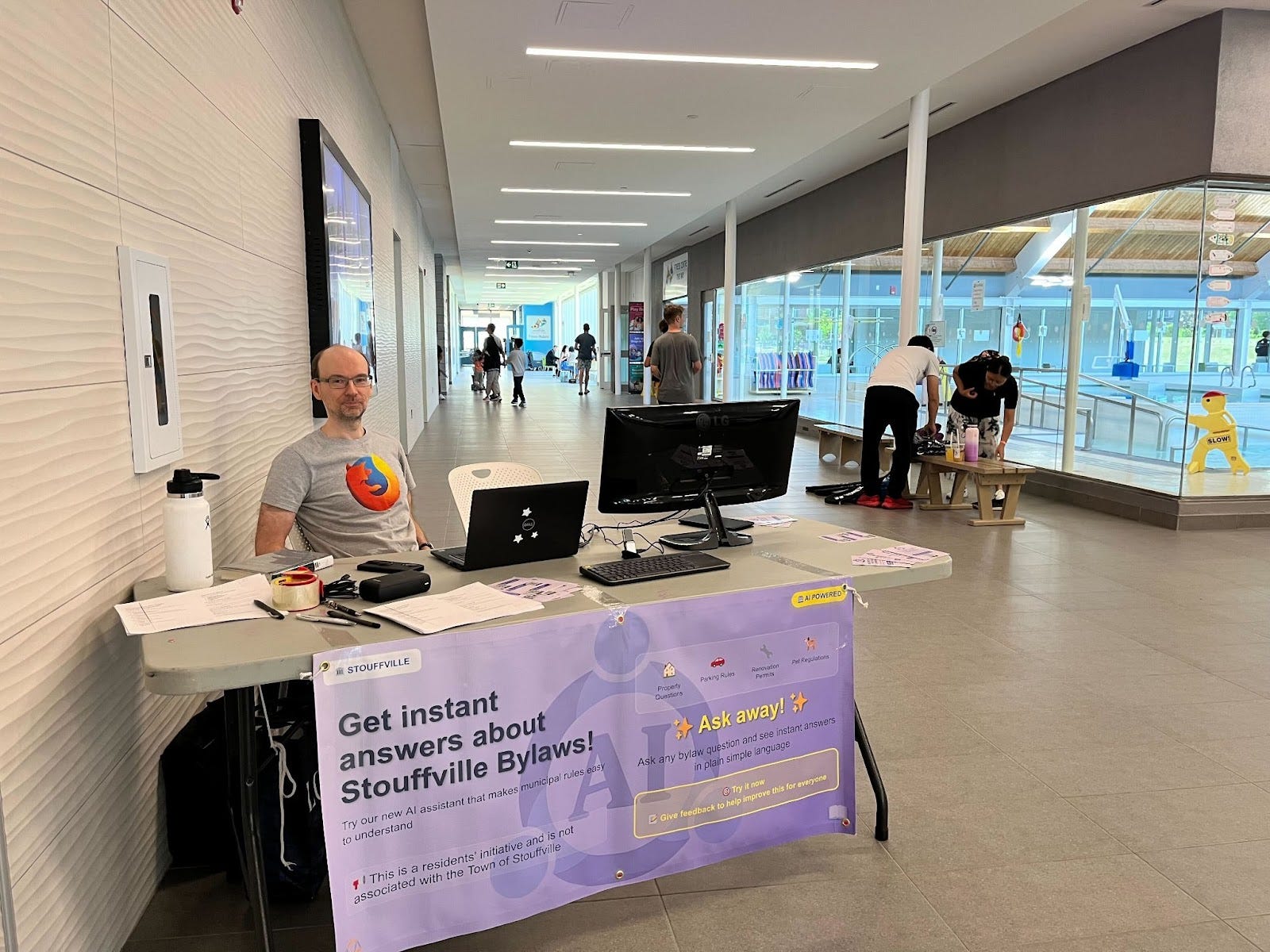
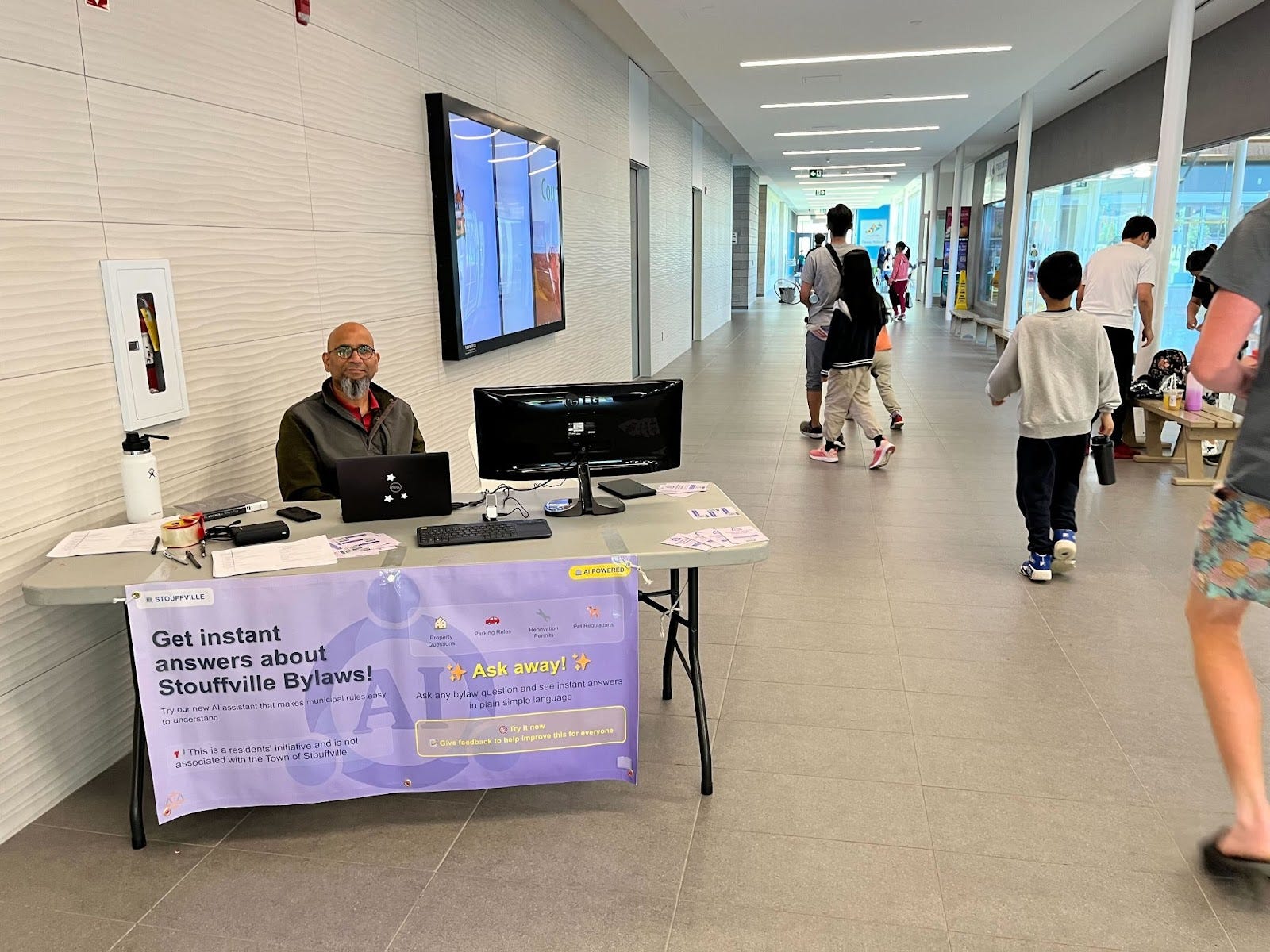
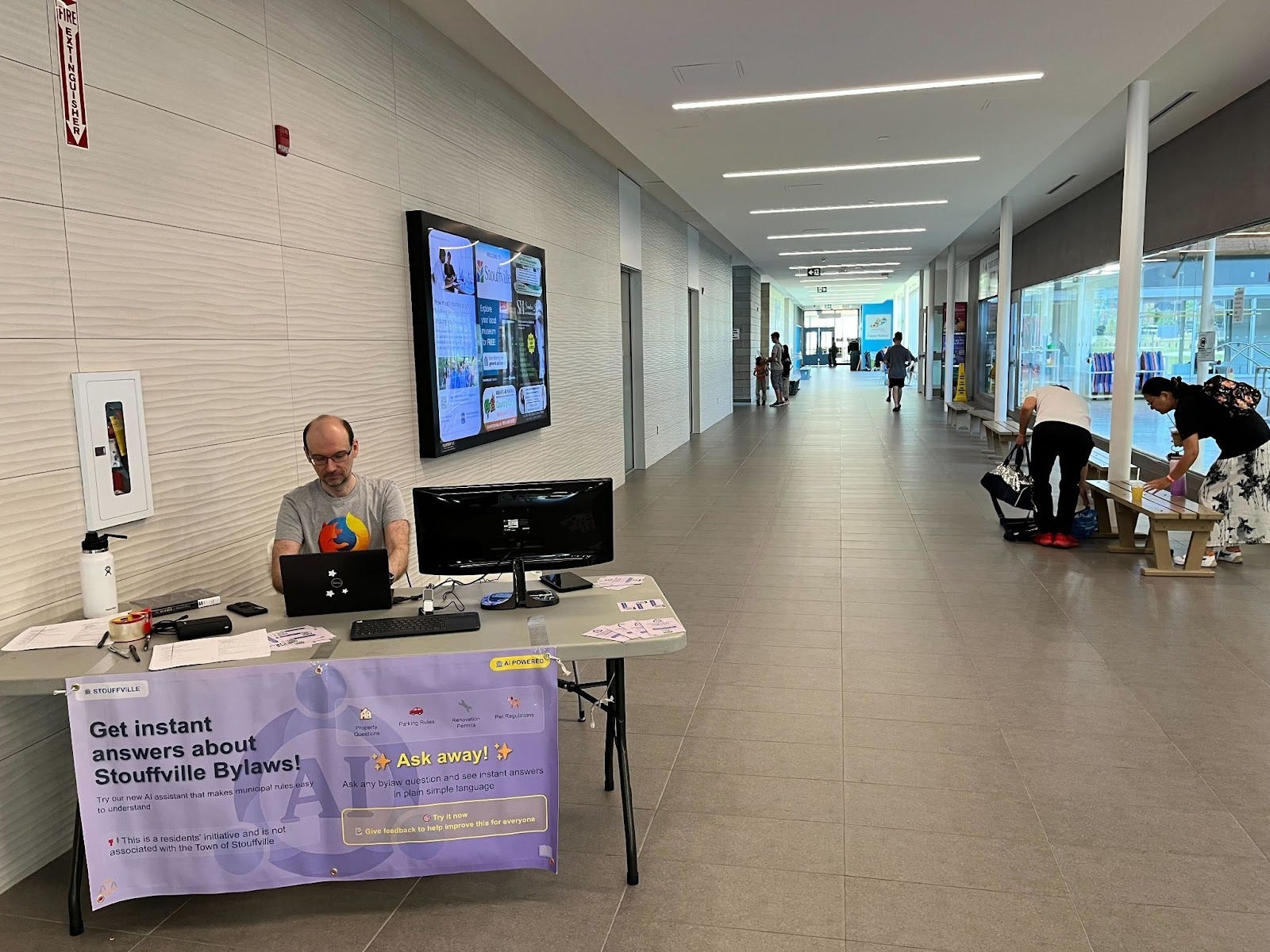
But Tom and I showed up anyway, armed with our poster, pamphlets with QR codes, and enough optimism to power a small generator (legally, as we later learned). Despite the modest foot traffic, our strategic positioning by the entrance, eye-catching poster, and two determined baldmen behind the desk managed to draw curious residents over.
Out of hundreds of people who walked past, about fifteen stopped to talk. Each conversation taught us something new.
The driveway guy who knew too much
First up: a gentleman who actually knew bylaw sections by number. His problem? Getting a permit to widen his driveway.
He rattled off his struggles:
Finding the right bylaw sections
Deciphering proportion specifications
Figuring out who at city hall could actually help
"I appreciate what you're doing," he said, "but my use may be minimal as it is very niche."
Fair point. But then he added: "I see a lot of potential for this application to go beyond basic needs."
Exactly.
The stop sign mystery
An elderly man approached asking about getting stop signs installed at his intersection.
My first thought: "That's provincial highway stuff, not municipal."
I was completely wrong.
Turns out, municipalities control stop sign installation based on traffic data and resident complaints. Our AI pointed him to the exact process and requirements.
One point for the machines.
The backyard fire question (plot twist)
An elderly couple wanted to know about backyard fires.
This one stumped our system—and for good reason. Fire restrictions come from fire departments, not municipal bylaws, and they change seasonally.
Sometimes the best answer is "wrong department, but here's who you need to call."
The flooding neighbor
A woman approached, clearly stressed. Her backyard floods constantly, and she suspected her neighbor's completely paved yard was the cause.
Our AI nailed this one. It found the specific drainage bylaws, explained her options, and gave her a clear path forward.
She walked away visibly relieved. This is why we built this thing.
The generator couple
"Can we run our generator all night?"
They were worried about noise complaints from neighbors. Valid concern—generators are loud, and community harmony matters.
The AI's answer: Generator noise does not fall under normal circumstances and is generally allowed operation.
Instant clarity. Problem solved.
Other curiosities
Throughout the day, we fielded other questions that showed just how varied residents' bylaw concerns can be. Someone asked about restrictions for flying kites—the kind of specific, everyday question that sends most people down rabbit holes of municipal websites.
The moment we knew we were onto something
Halfway through the day, Codey walked in. He's a local bylaw officer who happened to be at the Leisure Centre.
After seeing our demo, he said: "This would really help the whole community."
When the people who enforce bylaws for a living think your tool is useful, you're probably on the right track.
What demo day taught us
The biggest surprise? People's genuine awe when they realized residents had built this ourselves.
"Wait, you're not from the government?"
"Nope. Just neighbors who got tired of not understanding the rules."
Person after person expressed amazement—not just at having a comprehensive bylaw system, but at the fact that community members could harness AI to make municipal law actually understandable.
The bigger picture we're solving
The Facebook reality: Our local Facebook community groups are constantly buzzing with bylaw-related questions—people comparing how Stouffville handles something versus Markham or Richmond Hill, asking about property rules, noise complaints, you name it.
The problem? Most municipalities don't have comprehensive, searchable bylaw systems. When residents try to find answers about their town's rules, they hit dead ends or incomprehensible legal documents.
What we built for Stouffville—a system that can actually answer these everyday questions—turns out to be pretty unique.
Behind The Scenes
Tom went all-out on prep:
Built an AI Circle website and a chapter
Designed our logo and printed pamphlets
Made sure the system stayed stable all day
I focused on:
Setting up logging to track what worked and what didn't
Designing our attention-grabbing poster
Handling logistics and venue booking
Creating a feedback form for residents to fill
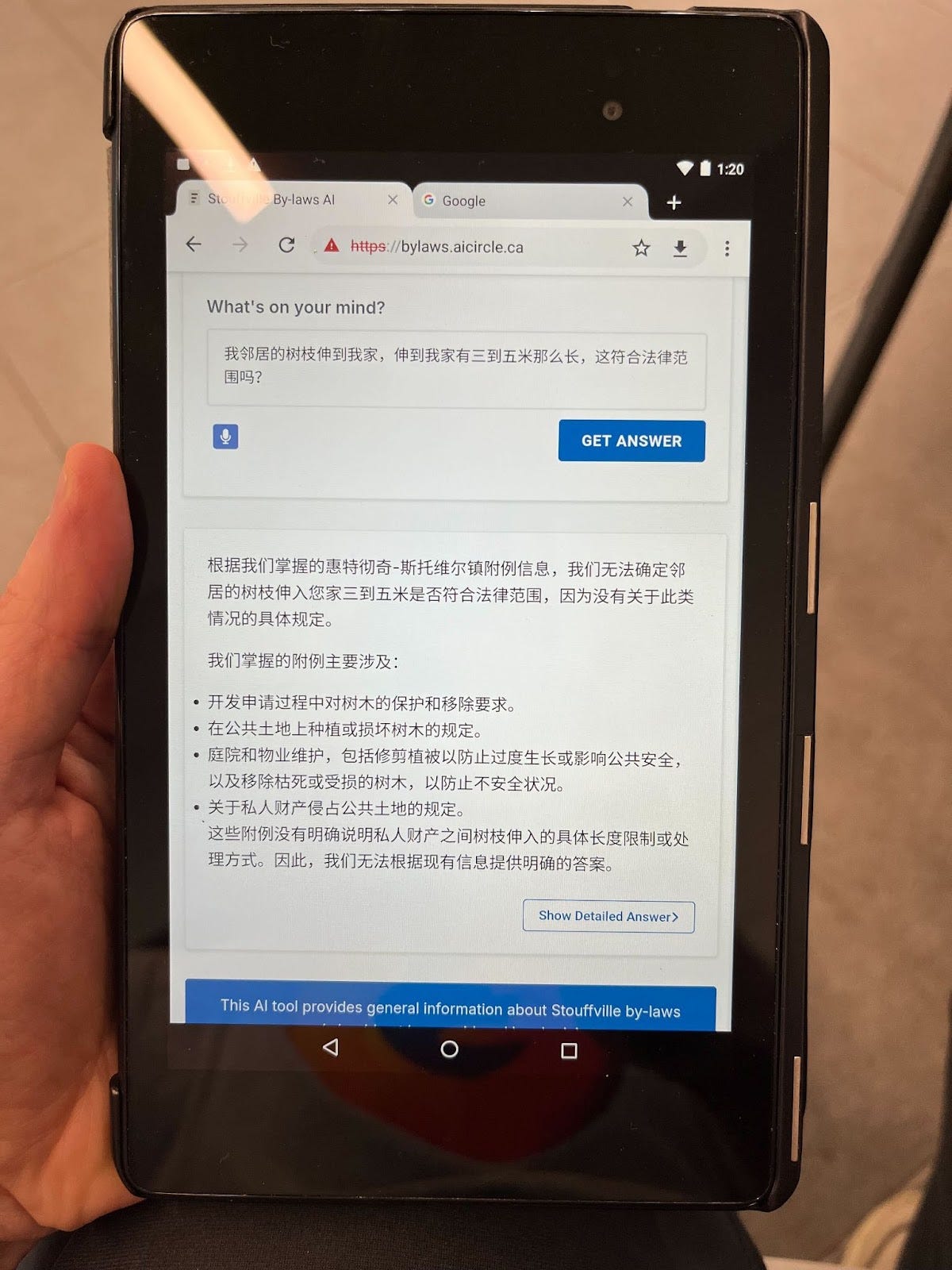
We also showcased voice input—ask questions in any language, get answers in text. Given our multicultural community, this accessibility feature got real appreciation.
What we learned about making laws accessible
What worked:
Quick answers to common questions (noise, property, drainage)
Voice input for accessibility
Clear explanations in plain language
What needs work:
Better boundaries between municipal vs. other jurisdictions - overall governing laws across York, Ontario, and Federal
More context about when to call the town vs. other authorities
What matters most:
Residents want specific answers to their specific situations
Even bylaw officers see the value in accessible legal information
Community-built solutions can actually work
Back to that teenager's question
Laws versus bylaws—the distinction matters, but accessibility matters more.
Laws evolved from centuries of philosophical debates about morals and social codes. Today's legal frameworks are incomprehensible to normal humans.
Our Stouffville project is one small step toward fixing that. We're not just answering questions—we're proving that communities can make their own governments more accessible.
Democracy works better when people understand the systems that govern them.
And sometimes, it takes a teenager asking the right question to remind you why the work matters.
Pictures or it did not happen
Want to explore the system yourself?
Check out our website at aicircle.ca
This represents my personal take on community civic engagement and doesn't reflect any professional affiliations.
What municipal law questions have you always wondered about? Hit reply—I'd love to hear what bylaw mysteries keep you up at night.
 | A guest post by
|